

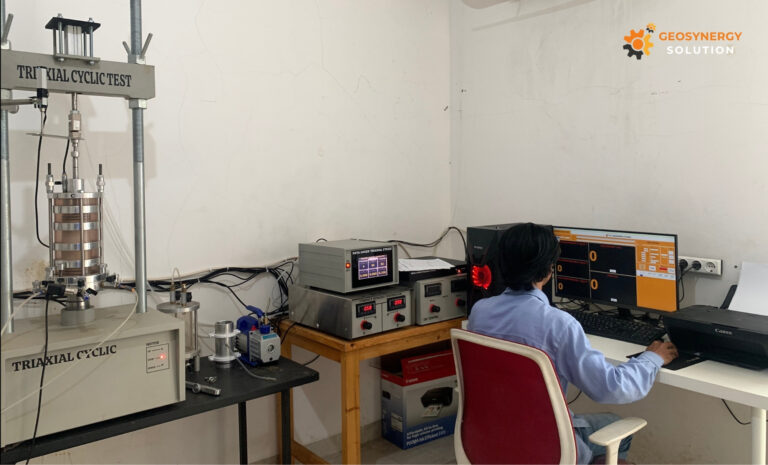
Understanding the Triaxial Cyclic Test: A Critical Soil Test in Geotechnical Engineering
In modern infrastructure development, understanding soil behavior under dynamic loads is essential. One laboratory test that plays a crucial role in this process is the Triaxial Cyclic Test in geotechnical engineering. This test helps engineers assess how soil responds to repeated or cyclic loading conditions, such as earthquakes, traffic loads, or offshore wave action.
What Is the Triaxial Cyclic Test?
The triaxial cyclic test is an advanced laboratory soil test conducted to evaluate the mechanical behavior of soil subjected to cyclic or repeated axial stresses. Unlike static triaxial tests, this method simulates real-life dynamic loading conditions that commonly occur in seismic and offshore environments.
As a result, engineers can better understand soil deformation, stiffness degradation, and pore water pressure buildup during cyclic loading.
Artikel terkait: What Is Triaxial Cyclic Test? Understanding Its Role in Geotechnical Engineering in Indonesia
Purpose of the Triaxial Cyclic Test in Geotechnical Engineering
The primary objective of the triaxial cyclic test in geotechnical engineering is to determine soil response under repeated stress conditions. Specifically, the test is used to:
Evaluate liquefaction potential
Analyze cyclic strength and stiffness
Assess soil deformation under seismic loading
Study pore pressure generation and dissipation
Therefore, this test is especially important for projects located in earthquake-prone regions.
How the Triaxial Cyclic Test Works
During the test, a cylindrical soil specimen is enclosed within a rubber membrane and placed in a triaxial chamber. The sample is subjected to confining pressure while cyclic axial loads are applied at controlled frequencies and amplitudes.
Consequently, engineers can measure parameters such as strain behavior, cyclic resistance ratio (CRR), and stress–strain relationships under dynamic conditions.
Applications in Engineering Projects
The triaxial cyclic test is widely applied in various engineering sectors, including:
Earthquake-resistant building design
Offshore and nearshore structures
Mining and tailings dam stability
Transportation infrastructure
Ground improvement verification
Moreover, the test supports performance-based design approaches by providing realistic soil behavior data.
Advantages of Using Triaxial Cyclic Testing
Compared to conventional static testing, triaxial cyclic testing offers several advantages:
Simulates real seismic and cyclic loading
Provides reliable liquefaction assessment
Improves foundation and slope stability design
Reduces geotechnical risk in critical projects
Hence, it is considered an indispensable tool in advanced geotechnical investigations.
Conclusion
The triaxial cyclic test in geotechnical engineering is a vital laboratory method for understanding soil performance under dynamic loading conditions. By delivering accurate insights into cyclic strength, deformation, and liquefaction potential, this test supports safer and more resilient infrastructure design.
For projects exposed to seismic or cyclic forces, triaxial cyclic testing is not just beneficial—it is essential.