

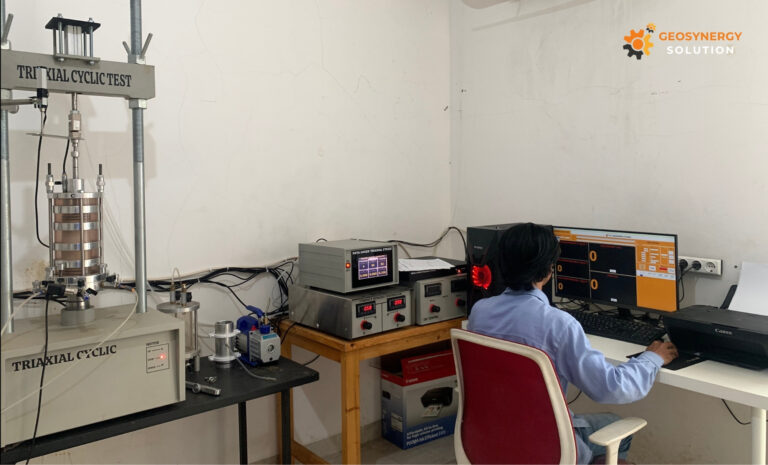
What Is Triaxial Cyclic Test? Understanding Its Role in Geotechnical Engineering in Indonesia
Indonesia is located along the Pacific Ring of Fire, making seismic activity a critical factor in infrastructure development. One laboratory test that plays a key role in understanding soil behavior under earthquake loading is the Triaxial Cyclic Test in Indonesia. This test is widely used in geotechnical engineering to evaluate soil response to repeated or cyclic loads.
Definition of Triaxial Cyclic Test
The Triaxial Cyclic Test is a laboratory soil testing method used to simulate cyclic loading conditions, such as earthquakes, waves, or machine vibrations. Unlike static triaxial testing, this method applies repeated axial stress to a soil specimen under controlled confining pressure.
The test helps engineers evaluate how soil behaves under dynamic conditions, including strength degradation, stiffness reduction, and excess pore water pressure generation.
Artikel terkait: Evaluating Soft Soil in Mining Areas Using the Consolidation Test
How the Triaxial Cyclic Test Works
In a typical Triaxial Cyclic Test in Indonesia, a cylindrical soil sample is enclosed in a rubber membrane and placed inside a triaxial chamber. Cyclic loads are then applied vertically while maintaining constant lateral pressure. Measurements such as stress, strain, and pore pressure are recorded throughout the test.
This process allows engineers to simulate real ground conditions experienced during earthquakes or repeated loading events.
Key Parameters Obtained from Triaxial Cyclic Testing
Some important parameters derived from the Triaxial Cyclic Test include:
Cyclic shear strength
Dynamic soil stiffness
Damping ratio
Liquefaction potential
Deformation characteristics under cyclic loads
These parameters are essential for safe and efficient geotechnical design.
Importance of Triaxial Cyclic Test in Indonesia
The Triaxial Cyclic Test in Indonesia is especially important due to the country’s high seismic risk. This test is commonly applied in:
Earthquake-resistant building design
Slope stability analysis under seismic loading
Foundation design for bridges, ports, and power plants
Mining and offshore infrastructure projects
Accurate cyclic soil data significantly reduce geotechnical risks and structural failure.
Triaxial Cyclic Test vs Static Triaxial Test
While static triaxial tests evaluate soil strength under monotonic loading, the Triaxial Cyclic Test focuses on soil behavior under repeated loads. This distinction makes cyclic testing more suitable for seismic and dynamic analyses, especially in earthquake-prone regions like Indonesia.
Applications in Geotechnical Engineering Projects
In modern geotechnical engineering, the Triaxial Cyclic Test in Indonesia is frequently used for:
Seismic site response analysis
Liquefaction assessment
Design of critical infrastructure
Performance-based geotechnical design
This test supports safer construction practices and long-term infrastructure resilience.