
Triaxial Test & Direct Shear Test by Geotechnical Consultant Indonesia
Triaxial Test & Direct Shear Test are two of the most essential laboratory procedures performed by Geotechnical Consultant Indonesia to evaluate soil strength and engineering behavior. These tests provide reliable data for foundation design, slope stability assessment, embankment analysis, road construction, and mining operations. Because soil strength directly affects construction safety, both tests play a critical role in minimizing structural failure risks.
What Is the Triaxial Test?
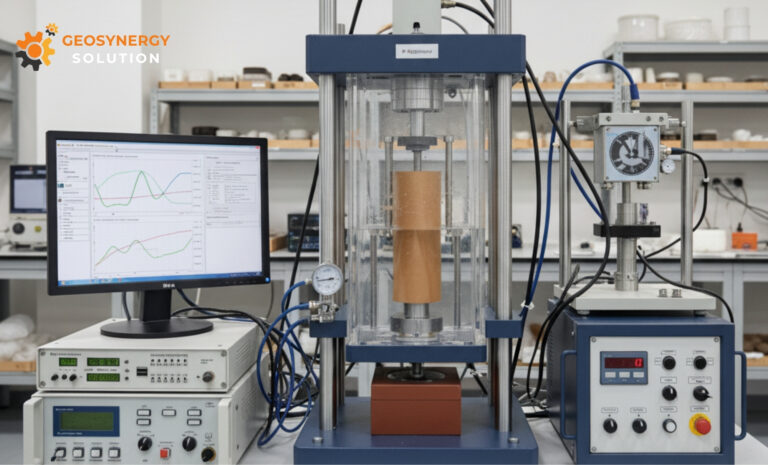
The Triaxial Test measures how soil behaves under different stress conditions. This test determines important parameters such as:
Cohesion (c)
Internal friction angle (φ)
Stress-strain behavior
Pore-water pressure
Shear strength under drained and undrained conditions
Geotechnical Consultant Indonesia conducts several types of triaxial tests, including:
Unconsolidated Undrained (UU)
Consolidated Undrained (CU)
Consolidated Drained (CD)
Because these tests simulate real field conditions, the results help engineers evaluate soil stability and predict deformation under load.
What Is the Direct Shear Test?
The Direct Shear Test is used to determine the shear strength of soil by applying horizontal force along a controlled plane. This method is simple, fast, and effective for analyzing:
Granular soils
Foundation materials
Slope materials
Embankment fill
Road base layers
The test provides two key parameters:
Cohesion (c)
Friction angle (φ)
As a result, engineers gain clear insight into soil behavior under shear stress.
Why These Tests Matter in Geotechnical Engineering
Both the Triaxial Test and Direct Shear Test provide critical soil parameters that directly influence engineering design. They help:
Improve foundation design accuracy
Reduce slope failure risks
Evaluate soil suitability for construction
Support ground improvement planning
Ensure compliance with ASTM and SNI standards
Because construction projects in Indonesia often face soil variability, Geotechnical Consultant Indonesia relies on these tests to deliver safe and reliable engineering recommendations.
How Geotechnical Consultant Indonesia Ensures Testing Quality
Professional consultants follow strict testing standards to guarantee accurate results. This includes:
Using calibrated laboratory equipment
Following ASTM D4767, ASTM D3080, and SNI test procedures
Proper sample preparation and classification
Digital data acquisition and reporting
With high-quality testing, engineers gain confidence in the performance and stability of critical structures.
Applications in Real Projects
These tests are commonly applied in:
Mining and excavation projects
Highway and bridge construction
High-rise building foundations
Dam and embankment design
Slope stability and landslide mitigation
Geotechnical risk assessment
The results support better decision-making and reduce the potential for costly construction failures.
The Triaxial Test & Direct Shear Test by Geotechnical Consultant Indonesia are essential for understanding soil strength and ensuring safe construction. With accurate laboratory testing, engineers can design safer foundations, reduce geotechnical risks, and support sustainable infrastructure development.