
Why Is the Triaxial Cyclic Test Highly Needed in Indonesia?
Indonesia is one of the most geologically dynamic countries in the world. Located along the Pacific Ring of Fire, the country experiences frequent earthquakes, volcanic activity, and complex soil conditions. These factors significantly influence the safety and stability of infrastructure and mining projects.
Because of these challenges, the Triaxial Cyclic Test plays a critical role in geotechnical engineering across Indonesia. This advanced laboratory test helps engineers evaluate soil behavior under repeated loading conditions, especially those caused by earthquakes.
In this article, we explain why the Triaxial Cyclic Test is highly needed in Indonesia and how it supports safe and sustainable development.
Understanding the Triaxial Cyclic Test
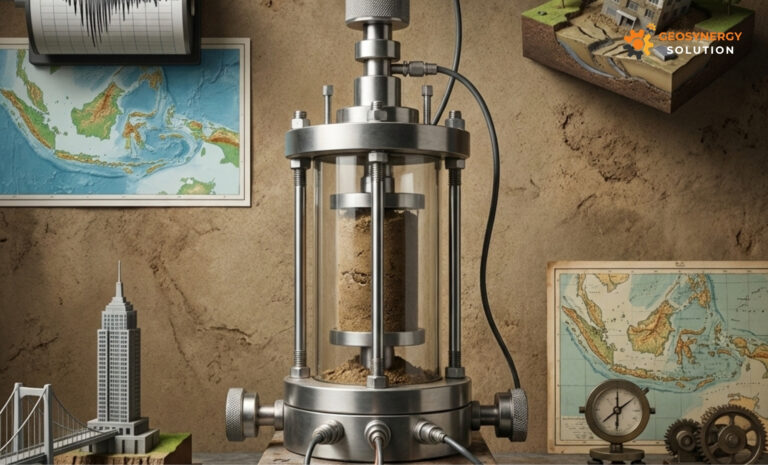
The Triaxial Cyclic Test is a laboratory test performed on soil samples to analyze their response under cyclic loading. Cyclic loading refers to repeated stress or pressure applied to soil, typically caused by:
Earthquakes
Machine vibrations
Traffic loads
Wave and offshore forces
Unlike static soil testing, this method simulates real dynamic conditions. It helps engineers understand how soil stiffness, strength, and pore water pressure evolve during repeated stress cycles.
Indonesia’s Geological Conditions and Seismic Risk
Indonesia faces significant seismic hazards due to:
Active tectonic plate boundaries
High earthquake frequency
Volcanic soil deposits
Coastal alluvial and soft clay formations
Many regions, including Jakarta, Sulawesi, Sumatra, and Java, contain loose saturated soils that are highly susceptible to liquefaction.
Liquefaction occurs when soil temporarily loses strength and behaves like a liquid during an earthquake. This phenomenon can cause:
Foundation failure
Slope instability
Ground settlement
Structural collapse
Therefore, accurate evaluation of liquefaction potential is essential in Indonesian projects.
Why the Triaxial Cyclic Test Is Highly Needed in Indonesia
1. Liquefaction Assessment in Earthquake-Prone Areas
One of the primary reasons the Triaxial Cyclic Test is highly needed in Indonesia is for liquefaction analysis.
This test allows engineers to:
Measure cyclic resistance ratio (CRR)
Evaluate pore water pressure buildup
Determine soil stiffness degradation
Assess cyclic shear strength
These parameters are crucial for designing earthquake-resistant foundations.
2. Supporting Major Infrastructure Development
Indonesia continues to develop:
Toll roads
Airports
High-rise buildings
Ports and offshore structures
Mining infrastructure
Dynamic loads from heavy traffic and industrial machinery can affect soil performance. The Triaxial Cyclic Test helps engineers design foundations that can withstand long-term cyclic stress without excessive settlement or failure.
3. Mining and Tailings Dam Safety
Indonesia has extensive mining operations. In tailings dams and embankments, cyclic loading from seismic activity poses serious risks.
The Triaxial Cyclic Test is used to:
Evaluate dynamic slope stability
Analyze cyclic softening behavior
Predict deformation during earthquakes
This helps prevent catastrophic failure and supports environmental protection.
4. Improving Design Accuracy and Safety
Using site-specific laboratory testing improves design reliability. Instead of relying solely on empirical correlations, engineers can obtain precise laboratory data from Triaxial Cyclic Testing.
This results in:
Safer foundation design
Optimized construction cost
Reduced geotechnical uncertainty
Better compliance with seismic design standards
In a country like Indonesia, where soil conditions vary greatly, accurate testing is essential.
How the Test Is Conducted
The Triaxial Cyclic Test involves:
Preparing a high-quality soil sample
Saturating the specimen
Applying confining pressure
Subjecting the sample to repeated axial loading
Monitoring stress, strain, and pore water pressure
The output data allows engineers to model real seismic behavior and evaluate liquefaction risk.
Who Needs the Triaxial Cyclic Test in Indonesia?
This test is highly recommended for:
Geotechnical consultants
Mining companies
Infrastructure developers
EPC contractors
Government infrastructure agencies
Projects located in coastal areas, reclaimed land, soft clay regions, or seismic zones particularly require this evaluation.
Indonesia’s geological complexity and seismic activity make advanced dynamic soil testing essential. The Triaxial Cyclic Test provides reliable data to assess liquefaction, soil stiffness degradation, and cyclic shear strength.
For infrastructure and mining projects in Indonesia, this test is not optional — it is a critical part of responsible engineering design.
Investing in proper geotechnical investigation today prevents structural failure tomorrow.