

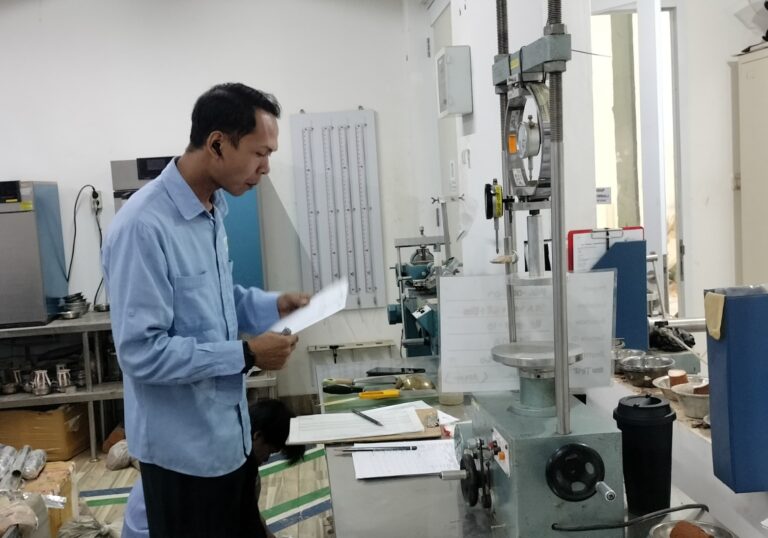
The Role of Triaxial Cyclic Testing in Planning High Seismic Risk Buildings
In regions exposed to high seismic activity, building design must address not only structural resistance but also ground behavior under cyclic loading. Therefore, understanding soil response during earthquakes becomes essential for safe and resilient construction. The role of triaxial cyclic testing in high seismic risk building design is particularly critical because it provides reliable data on soil behavior under repeated seismic loads.
Triaxial cyclic testing helps engineers predict soil performance, assess deformation potential, and design foundations that can withstand earthquake-induced stresses.
Understanding Triaxial Cyclic Testing
Triaxial cyclic testing is a laboratory method used to evaluate soil behavior under repeated cyclic loading, which simulates earthquake conditions. During the test, soil samples experience controlled axial and confining pressures while undergoing cyclic stress or strain.
As a result, engineers can measure key dynamic soil parameters such as stiffness degradation, damping ratio, cyclic strength, and accumulated strain. These parameters play a vital role in seismic design and risk mitigation strategies.
Artikel terkait: Simple Shear Cyclic Test Indonesia
Importance for High Seismic Risk Buildings
Buildings located in high seismic risk zones face significant ground motion during earthquakes. Consequently, soil behavior becomes a decisive factor in overall structural performance. The role of triaxial cyclic testing in high seismic risk building design lies in its ability to capture non-linear soil responses that traditional static tests cannot represent.
By using triaxial cyclic test results, engineers can:
Evaluate soil resistance to cyclic loading
Identify potential soil softening or failure
Assess deformation compatibility between soil and structure
This information directly supports safer foundation and structural design.
Application in Foundation Planning
Foundation systems such as shallow foundations, piles, and mat foundations must interact safely with surrounding soil during seismic events. Therefore, triaxial cyclic testing provides essential input for foundation design under earthquake loading.
Moreover, test results help engineers determine appropriate safety factors and select foundation systems that minimize excessive settlement, lateral spreading, or loss of bearing capacity during earthquakes.
Role in Liquefaction and Ground Response Analysis
One of the most important applications of triaxial cyclic testing involves liquefaction assessment. In saturated loose soils, cyclic loading may cause pore water pressure buildup, leading to a sudden loss of strength.
Through triaxial cyclic testing, engineers can evaluate liquefaction susceptibility, cyclic resistance ratio (CRR), and post-liquefaction behavior. Consequently, designers can incorporate effective ground improvement or mitigation measures into high-risk building projects.
Supporting Performance-Based Seismic Design
Modern seismic engineering increasingly adopts performance-based design approaches. In this context, triaxial cyclic testing plays a key role by providing realistic soil parameters for dynamic and numerical modeling.
With accurate soil input data, engineers can predict how buildings will perform under different seismic scenarios. As a result, the design can achieve targeted performance objectives such as life safety, immediate occupancy, or collapse prevention.
Benefits for Structural Safety and Sustainability
The integration of triaxial cyclic testing into seismic planning enhances structural safety while supporting long-term sustainability. Reliable soil behavior data reduces uncertainties in design assumptions and helps prevent overdesign or underdesign.
Furthermore, structures designed with accurate geotechnical input tend to perform better during earthquakes, reducing repair costs and minimizing operational downtime after seismic events.
The role of triaxial cyclic testing in high seismic risk building design is fundamental to understanding soil behavior under earthquake loading. By providing critical insights into soil strength, stiffness degradation, and deformation characteristics, this testing method supports safer, more resilient building design.
In high seismic zones, incorporating triaxial cyclic testing into the planning stage is not only a technical requirement but also a strategic decision to ensure long-term structural performance and risk reduction.