
loader image
Wet and dry drilling methods in soil investigation

Wet and Dry Drilling in Soil Investigation

Drilling is one of the main methods in soil investigation to determine subsurface conditions. Through this process, engineers collect essential data such as soil types, layer strength, and samples of soil or rock for laboratory testing. In practice, two drilling techniques are commonly applied: wet drilling and dry drilling. Understanding the differences between these two […]

Geotechnical drilling bits for soil and rock investigation in Indonesia

Bits in Geotechnical Drilling: Types, Functions, and Applications

Geotechnical drilling is a crucial part of soil and rock investigation for construction projects such as buildings, bridges, dams, and roads. One of the most important components in this process is the drill bit, which serves as the cutting tool that penetrates soil and rock layers. Choosing the right type of geotechnical drilling bit is

Standard Penetration Test SPT for foundation design in Indonesia

The Role of Standard Penetration Test (SPT) in Designing Safe and Efficient Foundations

In construction planning, the foundation plays a critical role in ensuring both safety and efficiency. A strong foundation supports structural loads and minimizes settlement that could otherwise damage the building. To achieve this, engineers rely on soil investigations. One of the most widely applied field methods in geotechnical engineering is the Standard Penetration Test (SPT).

Triaxial Cyclic Test in Indonesia for soil dynamic properties analysis

Triaxial Cyclic Test in Indonesia: Principles, Procedures, and Applications in Geotechnical Engineering

Triaxial Cyclic Test in Indonesia is an essential laboratory method in geotechnical engineering used to analyze the dynamic properties of soil. This test evaluates soil response to cyclic loading caused by earthquakes, traffic vibrations, or industrial machinery. By conducting this test, engineers can design safer and more resilient foundations, embankments, and infrastructure projects in one

Geotechnical engineering soil investigation for construction projects in Indonesia

Geotechnical Engineering – Soil Investigation Solutions for Construction Projects

Geotechnical engineering is a branch of civil engineering that studies the physical and mechanical properties of soil and rock to ensure the stability and safety of construction projects. This field plays a critical role in the planning, design, and execution stages of infrastructure development such as buildings, bridges, dams, ports, and mining projects. The Role

Geotechnical consultant in Indonesia providing soil investigation services

Professional Geotechnical Consultant in Indonesia – Data-Driven Construction Solutions

Indonesia, with its high geotechnical risks such as landslides, earthquakes, and expansive soils, requires reliable and experienced geotechnical consultancy services. PT Geo Sinergi Utama, through its brand GeoSynergy Solution, is recognized as one of the leading geotechnical consultants in Indonesia, delivering accurate, data-driven, and integrated solutions for construction, mining, and infrastructure projects. What is a

CPTu equipment operation in a geotechnical field test

How CPTu Equipment Works and Its Applications in the Field

What is CPTu? The CPTu test in geotechnical engineering is an advanced soil investigation method developed from the standard Cone Penetration Test (CPT). By adding pore pressure measurement, the CPTu test provides more detailed insights into subsurface conditions, including soil strength, stratigraphy, and liquefaction potential. How the CPTu Test in Geotechnical Engineering Works A CPTu

Dynamic Cone Penetrometer (DCP) test in soil investigation

Dynamic Cone Penetrometer (DCP)

What is a Dynamic Cone Penetrometer (DCP)? In construction and geotechnical engineering, understanding soil characteristics is a crucial first step to ensure safety and efficiency. To achieve this, engineers often rely on the Dynamic Cone Penetrometer (DCP), which is one of the most widely used field-testing tools for direct soil investigation. A Dynamic Cone Penetrometer

Disturbed soil sample collected during geotechnical investigation in Indonesia

Disturbed Sample (DS) in Geotechnical Investigation

What is a Disturbed Sample (DS)? A Disturbed Sample (DS) refers to a soil or rock specimen whose natural structure has been altered during the sampling process. This disturbance may include changes in density, particle arrangement, or moisture distribution. Although a Disturbed Sample does not represent the exact in-situ condition of the soil, it still

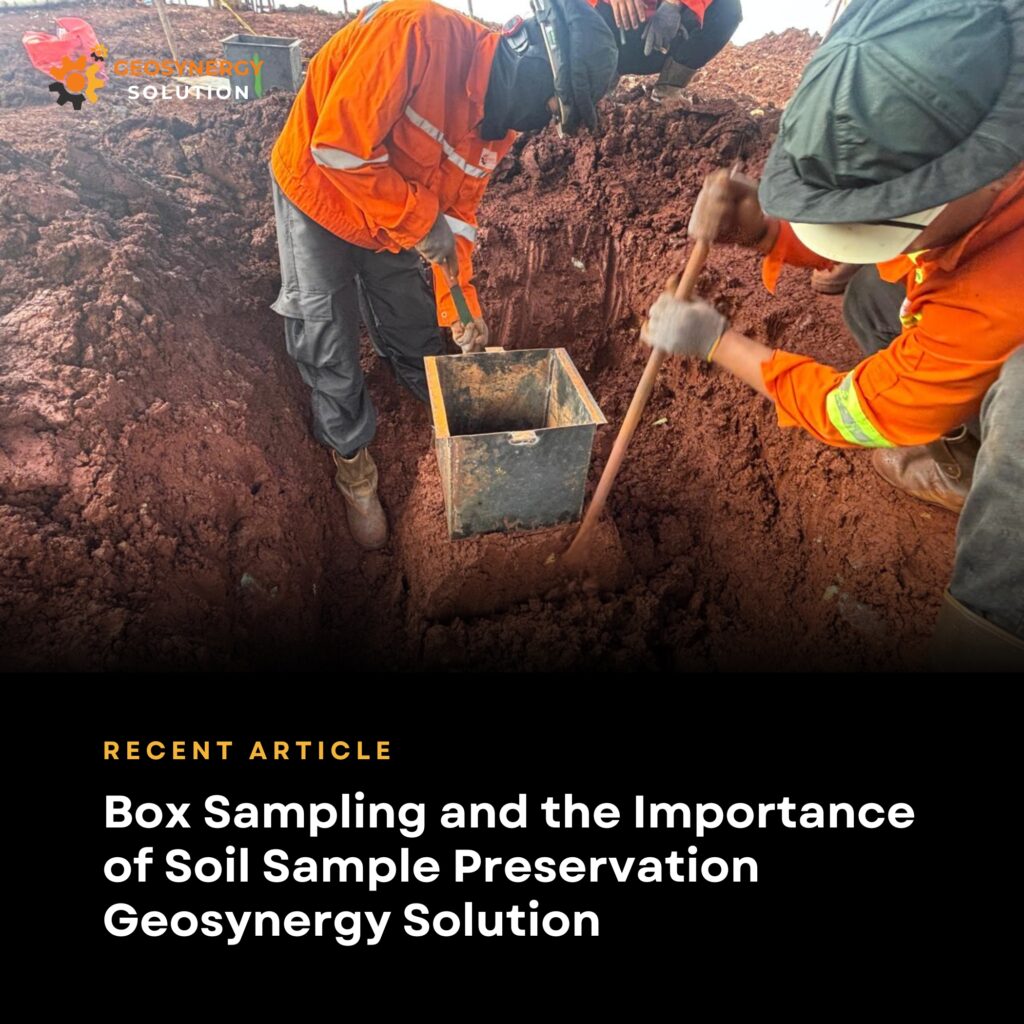
Box Sampling method for soil and rock sampling in geotechnical engineering

Box Sampling – Soil and Rock Sampling Method

What is Box Sampling? Box Sampling is a soil and rock sampling method carried out by manually excavating a square or rectangular pit of a specific size. This technique is primarily used to collect bulk samples or disturbed samples from a targeted geological layer. Key Characteristics of the Box Sampling Method Applied at the surface

Scroll to Top