
Differences Between Pontoon and Barge for Construction and Mining Activities
Floating platforms play a critical role in marine-based construction and mining operations. For this reason, selecting the right type of floating structure directly affects safety, efficiency, and overall project success. Therefore, contractors, engineers, and project owners must clearly understand the differences between pontoon and barge for construction and mining activities, especially when operating in coastal, riverine, or offshore environments.
Although people often consider pontoons and barges similar, in reality, each serves a different function and supports specific operational needs. In this article, we explain these differences clearly to help you choose the most suitable option for your project requirements.
What Is a Pontoon?
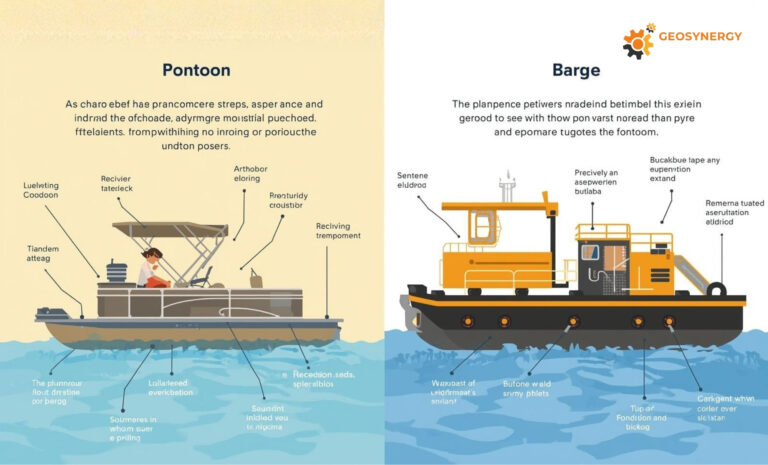
A pontoon functions as a floating platform that provides a stable working surface, rather than acting as a transportation vessel. Engineers commonly use pontoons as bases for construction activities, drilling operations, geotechnical surveys, and temporary offshore structures.
Moreover, pontoon designers often add systems such as spud poles, jack-up legs, or anchoring mechanisms to improve stability in shallow waters. As a result, pontoons work exceptionally well for projects that require precise positioning and minimal movement during operations.
What Is a Barge?
A barge is a flat-bottomed vessel that primarily supports the transportation of materials, equipment, and heavy loads across water. In construction and mining projects, teams frequently use barges to move heavy machinery, construction materials, and bulk cargo between locations.
However, unlike pontoons, operators usually tow or push barges using tugboats. Because of this, barges prioritize load capacity and mobility instead of stability at a fixed position. Consequently, their design makes them highly effective for logistics and mobilization activities.
Key Differences Between Pontoon and Barge
To better understand the differences between pontoon and barge for construction and mining, consider the following key aspects:
1. Function
Pontoon: Acts as a stationary or semi-stationary working platform.
Barge: Serves mainly as a transportation vessel for materials and equipment.
2. Stability
Pontoon: Provides higher stability through anchoring systems or jack-up mechanisms.
Barge: Offers limited stability when stationary because it is designed primarily for movement.
3. Load Application
Pontoon: Supports operational equipment such as drilling rigs, cranes, and survey tools.
Barge: Carries heavy cargo but does not function as a fixed work platform.
4. Typical Usage
Pontoon: Supports offshore construction, geotechnical drilling, marine surveys, and platform installation.
Barge: Supports material transport, equipment mobilization, and logistical operations.
Applications in Construction Projects
In marine construction, teams commonly use pontoons for piling works, bridge construction, and offshore installations because these activities demand high stability and precision. Meanwhile, barges play a vital role in delivering construction materials and heavy equipment to project sites efficiently.
Therefore, selecting the wrong platform can lead to operational delays, increased safety risks, and higher project costs.
Applications in Mining Activities
In mining operations, operators often use pontoons during offshore drilling, environmental monitoring, and survey activities. Their stable platform supports sensitive operations that require accurate positioning. At the same time, barges handle mining logistics by transporting fuel, equipment, and extracted materials.
By understanding these roles, project teams can deploy resources more effectively and improve overall project performance.
The differences between pontoon and barge for construction and mining mainly relate to function, stability, and operational use. In general, pontoons work best as stable work platforms, while barges excel as transport vessels. Therefore, selecting the right platform based on project requirements will significantly improve safety, efficiency, and cost effectiveness.
Finally, partnering with experienced consultants such as Geosynergy Solutions helps ensure that marine operations follow the right technical approach and comply with industry best practices.