

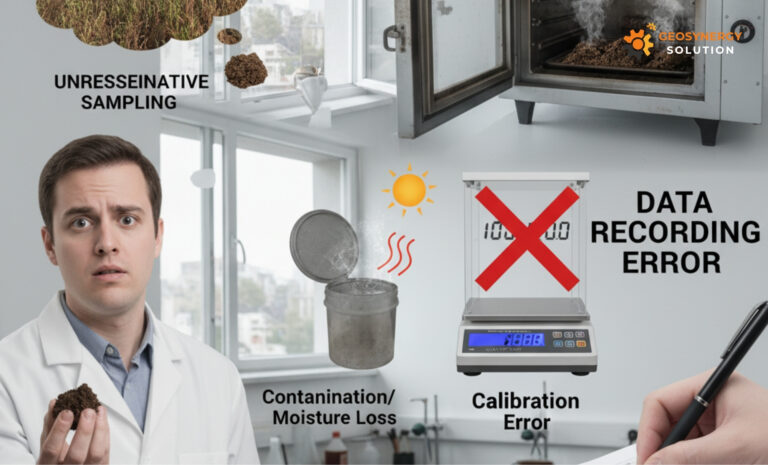
Common Errors in Soil Moisture Testing and How to Avoid Them
Accurate determination of soil moisture content is essential in geotechnical engineering. The results influence soil classification, compaction analysis, foundation design, slope stability evaluation, and settlement estimation. However, errors in soil moisture testing are common and can lead to misleading interpretations and engineering decisions.
Below are the most common errors in soil moisture testing and professional methods to prevent them.
1. Inadequate Sample Handling
Improper handling is one of the main causes of inaccurate soil moisture results. Soil samples that are exposed to open air for too long lose water naturally, changing their true moisture content.
How to Avoid It
Store samples in airtight containers immediately after sampling.
Minimize exposure to open air during preparation.
Process the sample as soon as possible.
2. Improper Oven Temperature Control
The oven drying method is widely used for moisture content testing. However, placing samples in an oven that is too hot or too cold produces inconsistent results.
Best Practices
Maintain the oven temperature between 105°C ± 5°C as recommended by ASTM standards.
Avoid testing with unstable or fluctuating oven temperatures.
Calibrate the oven periodically to ensure accuracy.
3. Incorrect Weight Measurement
Small errors during weighing can significantly affect moisture calculation, especially with fine-grained soils and small sample masses.
Prevention Tips
Use a precision balance with proper calibration.
Keep the balance clean and free of dust.
Weigh samples only after they reach stable temperature.
4. Incomplete Soil Drying
Some soils, especially clay-rich materials, require additional drying time due to their ability to retain moisture. If removed too early from the oven, the recorded moisture content will be lower than the actual value.
How to Prevent It
Extend drying time for clay soils or confirm stability by re-weighing at intervals.
Ensure the sample temperature has stabilized before weighing.
5. Contamination During Testing
Foreign materials such as dust, spilled water, or mixing tools can contaminate the soil sample and change the true moisture percentage.
How to Prevent It
Maintain a clean testing area at all times.
Use dedicated containers and tools for each sample.
Avoid contact with unnecessary water sources during preparation.
Artikel terkait: Evaluating Soft Soil in Mining Areas Using the Consolidation Test
6. Human Calculation Mistakes
Manual calculation errors still occur in many laboratories, even though the moisture equation is straightforward.
Solutions
Use structured worksheets or digital calculation tools.
Double-check the weight difference before calculating.
Implement a checker system for data validation.
Why Accurate Soil Moisture Testing Matters
Reliable soil moisture data ensures:
Accurate soil classification
Better compaction control
Improved settlement prediction
Safer foundation and slope design
Higher confidence in geotechnical decision-making
Reducing testing errors leads to more reliable laboratory output and safer engineering designs in the field.
Why Choose PT Geo Sinergi Utama?
PT Geo Sinergi Utama provides high-quality geotechnical laboratory services with strict quality control, standardized testing procedures, and trained professionals. Our moisture testing services deliver reliable data used to support mining, construction, environmental, and civil engineering projects across Indonesia.